When the Bourse de Commerce opened as an art museum in 2021, a monumental sculpture in its rotunda began to melt. Urs Fischer’s installation included a wax replica of Giambologna’s The Abduction of the Sabines, fitted with wicks. Lit during the exhibition, it gradually lost its shape beneath the building’s restored dome.
It was a striking choice for the opening of François Pinault’s Paris museum. Years had gone into restoring the building. At its centre stood an artwork designed to come apart.
Pinault’s business began in timber and building materials in 1962. Through retail acquisitions and, later, the purchase of Gucci, the company developed into the group now known as Kering. Alongside it, he established the family investment company Artémis in 1992. Contemporary art became another substantial undertaking, with exhibition spaces in Venice preceding the Paris project.
Palazzo Grassi opened under the Pinault Collection in 2006, followed by Punta della Dogana in 2009. Tadao Ando worked on both. The architect’s task in Paris continued that relationship: finding room for contemporary art within a building whose earlier uses remained plainly visible.
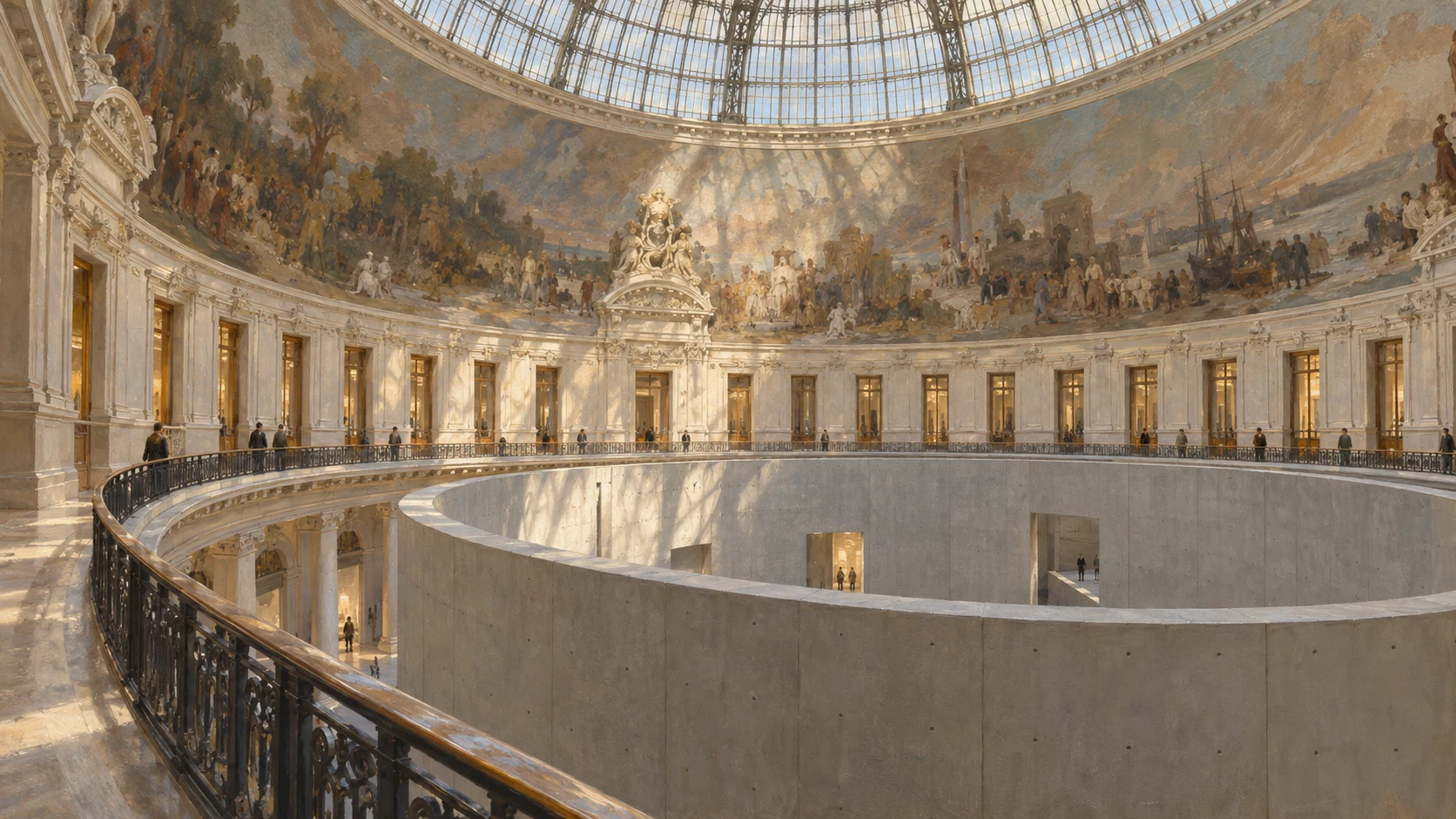
The Bourse had already been repeatedly altered. A circular grain exchange was built on the site in the eighteenth century, initially with an open central courtyard. A timber dome followed, then an iron replacement after a fire. In the late nineteenth century, architect Henri Blondel transformed the structure into the Bourse de Commerce, inaugurated in 1889. The painted panorama beneath the dome belongs to that reconstruction.
Ando placed a concrete cylinder inside the rotunda, its walls rising nine metres above the floor. Above it, the dome reaches thirty-five metres. The intervention creates an exhibition space within the larger room while leaving the historic architecture visible overhead.
“I drew a circle in the circle,” Ando explained in an interview published by the museum. He also connected the form to the Japanese artist Jirō Yoshihara, whose repeated painted circles were central to his work.
The concrete is the most recognisable addition, but the conversion depended on less conspicuous work. The project brought together Ando’s practice, Niney et Marca Architectes, heritage architect Pierre-Antoine Gatier and engineering firm Setec Bâtiment. Restorers worked across approximately 1,400 square metres of painted canvas beneath the dome. Its glazing was replaced to improve thermal performance and control sunlight while retaining the room’s luminosity.
The inaugural exhibition, Ouverture, brought together two hundred works by more than thirty artists across ten exhibition spaces. Pinault was named as its curator. It gave visitors a substantial selection from his collection, arranged for this particular building.
Fischer’s installation was reworked specifically for the rotunda. Alongside the Giambologna replica were a wax figure of painter Rudolf Stingel and an assortment of chairs, including a plastic garden chair and aircraft seats. Their familiar forms shared the same material and the same eventual fate.
That opening remains a useful way to understand the Bourse. The restored painting, Ando’s concrete and Fischer’s burning sculptures occupied the room together, each asking for a different kind of attention. A visitor could look up at the nineteenth century, walk through a new architectural intervention and return weeks later to find the central artwork visibly changed.
Sources & further reading
- Pinault Collection · Urs Fischer, Untitled ↗
- Artémis · Kering history ↗
- Artémis · The group ↗
- Pinault Collection · Venice ↗
- Bourse de Commerce · Restoration ↗
- Bourse de Commerce · Tadao Ando interview ↗
- Bourse de Commerce · Project team ↗
- Pinault Collection · Ouverture ↗
- Pinault Collection · Opening press kit ↗